| Anga | |
|
The Anga are divided into linguistic tribes such as the Aseki, Kapau, Iwini, Baruya, and the Watut and others known from ethnography. |
What tribe is that? - The upper Watut The Watut are a regional subdivision of the wider Anga cultural and linguistic area. Here you'll find some information about this tribe. |
| Banaban | |
|
The Hmong are divided in two sub-groups, White and Blue. They live in the mountainous regions of China, Vietnam, Laos and Thailand. The Hmong live in houses that sit right on the ground, not on stilts as do some other hilltribes. For a long time the Hmong have supported themselves by the cultivation of opium poppy. Most of the Hmong people are turning from opium growing, and are now seeking to market their exquisite needlework in order to supplement their income. |
The Banaban Heritage Society A non-profit International organization that has been formed in Australia dedicated to the preservation of Banaban Culture and bettering the lives of the Banaban people of Banaba/Ocean Island and Rabi Islands in the Pacific. |
| Maori | |
|
The first people to arrive at the Islands now known as New Zealand were Polynesians who sailed from their ancestral homeland which they called Hawaiki and whose actual location has been lost in time. The first expedition, about 950 A.D., was led by a chief, Kupe, who returned home with precise navigational instructions for reaching the new land, Aotearoa. Aotearoa (New Zealand) features alpine mountains, fjords, glaciers, lakes, swift rivers and vast forests and her climate ranges from sub-tropical to temperate. Adapting to the new conditions, the Maori built homes of timber, became the most skilled woodworkers in Polynesia, and made their clothing of woven flax rather than tree bark. They developed a tribal society ruled by hereditary chiefs and a powerful priesthood. The tribes became rivals and lived in fortified villages, pa, centered around a marae, or main courtyard. New Zealand was discovered by the Dutch explorer Able Tasman. Europeans came in droves to exploit the natural resources. In 1840, the British signed The Treaty of Waitangi with the Maori chiefs, promising to protect their lands from exploitation and making New Zealand a British colony. Maoris today comprise about 12 percent of the predominantly European population of New Zealand.  |
Aotearoa
- New Zealand Culture, music, dance of the Maori, and a map of New
Zealand. Maori Organizations in New Zealand Maori carving, Maori Culture/Performing Arts, Maori Language, Maori Gatherings (Hui), Myths and Legends, Links. Lonely Planet - Maori Historical information about the Maori Discover New Zealand - Travel Guide - Maori Culture The Maori culture. Wellington's History The Maori: past, present and future. Facts about New Zealand: Maori Maori Origin, Religion, Culture and Art. Ross Himona's Maori Homepage a Maori in cyberspace |
| Fiji | |
|
Fiji is a nation of 322 Islands spread like a horseshoe in the blue Pacific embracing the Koro Sea. The Fijians are the pottery makers of Polynesia. Archaeologists, dating shards of their lapita pottery, estimate the arrival of the first Polynesians in Fiji near 1500 B.C. They were skilled seafarers, builders and weavers of sennit and palm fronds. European discovery happened gradually, over a period of 300 years beginning in 1643. During the colonial period, the English established cotton and sugar plantations. Finding the Fijians uninterested in their material culture based on wages, the English imported workers from India. |
Islands of Fiji Culture, music, dance, map of Fiji. |
| Hawaii | |
|
Living for centuries in isolation, the Hawaiians developed a unique culture, in harmony with their limited island environment, ordered a highly structured society of nobility and commoners, and used their religion as a system of law. The impact of the encounter with the rest of the world was immediate and devastating. Within a few years, foreign diseases, to which the Hawaiians had developed no immunities, decimated the population. New plants and animals altered the environment, and their traditional culture was virtually eclipsed. Thanks to both the steadfastness of people who quietly nurtured aspects of their heritage, and efforts such as that of the Polynesian Cultural Center, there is currently a strong renaissance of Hawaiian culture throughout the Islands. |
Islands
of Hawaii Culture, music, dance, map of Hawaii.
Hawai'i
- Independent & Sovereign Nation-Stateprovides information
regarding the restoration of the independence of Hawai`i, along with
cultural perspectives from her people. |
| Marquesas | |
|
The ancient valley people of the Marquesas, separated from each other by mountainous terrain and treacherous seas, developed insular little societies, jealous and warlike. Their artwork, particularly in wood, was striking and they left behind beautiful bowls, fan handles, intricate ironwood war clubs and impressive tikis. They also carved massive god Images in stone. It was from these Islands that expeditions set forth to colonize Hawaii and Easter Island off the coast of South America. Contact was the beginning of the end for the Marquesan people. Foreign diseases, slave raids, the introduction of opium, the continuation of their own warfare and cannibalism killed 95 percent of the population. Norwegian explorer and anthropologist Thor Heyerdahl lived on Fatu Hiva in 1936 and wrote a book, Aku Aku, about his time in this remote place. 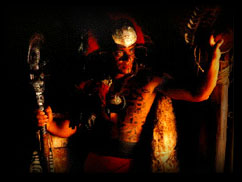 |
Islands of Marquesas Culture, music, dance, map of Hawaii. |
| Samoa | |
|
Early explorers arrived in the Samoan islands about 1,000 B.C. and became, culturally, the Polynesian people. From there, they set out on further voyages to Tahiti and the Marquesas. In Samoa, the matai, or chief system, is the working social order. With the extended family as its nucleus, it is a pyramidal structure with the village chief administering affairs and making decisions. The family or village chief is responsible to the high chiefs, high talking chiefs and paramount chiefs-more than 20,000 chiefs in all. It is a system of behavior that has functioned well for over a thousand years. Many Samoan people live on their verdant, volcanic islands, much as they have for centuries, in open-sided, thatch-roofed fale, or oval homes. They have an instinctive joy in life and are often called the Irish of the Pacific. They have also been likened to the Greeks because the Polynesian culture developed its distinctive characteristics here. |
Islands
of Samoa Culture, music, dance, map of Samoa. Samoa Lots of (tourist) information about Samoa. It also has some cultural information. |
| Tahiti | |
|
Three thousand five hundred years ago some South East Asians explorers set out from the area of Malaysia and Indonesia on a migratory trek which would lead them to make the many islands of Polynesia their home. Great voyagers, they sailed their huge double-hulled canoes far and wide, steering with huge paddles and pandanus sails. Perhaps the most famous alternative theory, expounded by the adventurer Thor Heyerdahl, is that Polynesians may also have migrated from South America. The first Polynesian islands settled were Tonga and Samoa; the oldest known dwelling site on Tongatapu dates from 1200 B.C. Around the time of Christ they pushed out into the eastern half of the Pacific from this primeval area remembered as Havaiki. About A.D. 300 they reached the Marquesas from Samoa, and somewhere around A.D. 500 they sailed on from the Marquesas to Hawaii and Easter Island. They were on the Society Islands by A.D. 800 and sailed from there to the Cooks and New Zealand around A.D. 1009, completing the occupation of the Polynesian triangle. When for some reason, whether tribal warfare or overpopulation, Polynesians had to settle elsewhere, they put their families, worldly goods, plant cuttings, animals and several months worth of supplies of food into their canoes and set sail to find new homes. 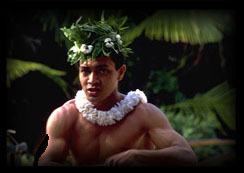 |
Islands of Tahiti Culture, music, dance, map of Tahiti. |
| Tonga | |
|
Tonga is one of the few countries in the world, and the only one in Polynesia, never to be colonized by a European power. The warriors of Tonga were feared throughout Polynesia and their kalia, or canoes, carried their armies to far shores. At one time the empire of the Tu'i Tonga, or hereditary king, extended from Rotuma in the west to Niue in the east, and included much of Samoa. |
Islands
of Tonga Culture, music, dance, map of Tonga.
Tonga Page Human Rights, newspaper articles, the
Royal Family, photo album, maps, literature and links. |
| Other Links | |
Pacific Islands Internet Resources Home Page A catalog of the resources available via the World Wide Web focusing on the Pacific Islands. Papua New Guinea - What tribe is that? Links to pages about the people of Papua New Guinea. Lonely Planet - Destination Papua New Guinea General information about PNG and its inhabitants. Papua New Guinea Virtual Library A well-organised collection of resources. |
|